
- Home
- »
- Agrochemicals & Fertilizers
- »
-
Formic Acid Market Size, Share & Growth Report, 2026-2033GVR Report cover

Formic Acid Market (2026 - 2033)
Size, Share & Trends Analysis Report By Grade Type (Industrial, Feed, Pharmaceutical, Reagent), By Application (Animal Feed & Silage Preservatives, Leather Tanning, Textile Dyeing & Finishing, Rubber Production), By Region, And Segment Forecasts,
Market Size, 2025
$1.1BMarket Estimate, 2026
$1.2BMarket Forecast, 2033
$1.7BCAGR, 2026–2033
4.8%Formic Acid Market Summary
The global formic acid market size was valued at USD 1.1 billion in 2025 and is projected to grow from USD 1.2 billion in 2026 to USD 1.7 billion in 2033, at a CAGR of 4.8% from 2026 to 2033. Asia Pacific dominated the global market, accounting for the largest revenue share of 35.0% in 2025. Growing demand for preservatives in silage, utilization of chemical products in industries, and adoption of environment-friendly products in leather and textile manufacturing are some of the major factors responsible for the growth of the market.
Key Market Trends & Insights
- By grade type: The industrial segment held the largest market share of in 2025.
- By application: The animal feed and silage additives segment held the largest market share in 2025.
Regional Highlights
- Largest regional market: Asia Pacific (35.0% revenue share, 2025)
- Fastest-growing regional market: North America (highest CAGR, 2026-2033)
Market Size & Forecast
- Market size in 2025: USD 1.1 Billion
- Estimated market size in 2026: USD 1.2 Billion
- Projected market size by 2033: USD 1.7 Billion
- CAGR (2026-2033): 4.8%
Three ways to get this report
Buy it, customize it, or ask a question.Ask an Analyst
A direct answer, usually in 1 working day
- AccessReport author, directly
- Reply timeWithin 1 working day
- No sales callDirect answer only
- FormatEmail reply
- CostFree, no cost
Get the Full Report
What the study covers
- FormatsPDF · Excel · Dashboard
- Timeline2026–2033 annual, 2025 base
- Coverage20+ countries, 5 regions
- Companies10+ key players profiled
Customize the Report
20% free customization
- IncludeCountries, segments, points
- TailorTo your product definition
- ExtendDeeper competitor detail
- OrA fully bespoke study
- Turnaround5–10 working days
Formic acid is a colorless, pungent, and highly corrosive organic acid used as a preservative, antibacterial agent, and pH regulator in animal feed, as well as in leather tanning, rubber manufacturing, textile processing, and other industrial applications. Market growth is driven by rising demand for animal feed additives, increased adoption of sustainable agriculture, and greater investment in bio-based formic acid. Advances in production technologies are also transforming the supply landscape.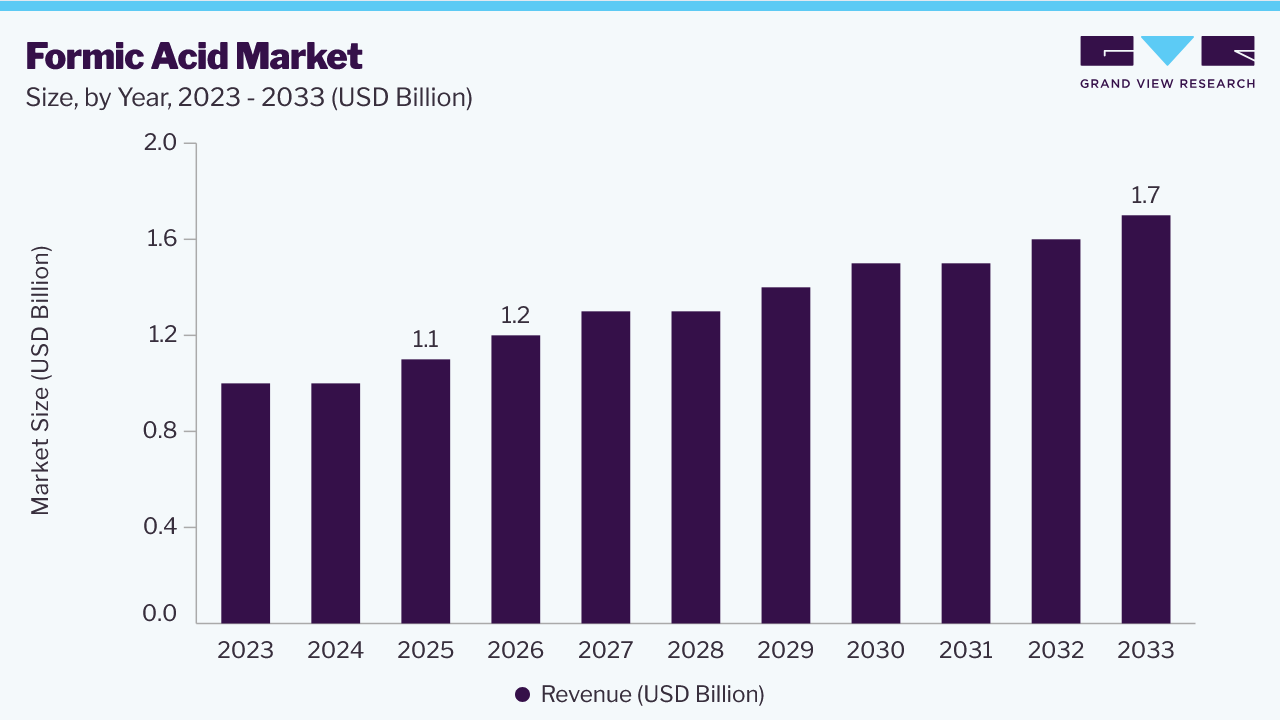 Source: Grand View Research, IR Documents, Primary Interviews, Paid DatabasesTo learn more about this report,
 Download Free Sample Report
 Methyl formate hydrolysis remains the primary commercial production method. However, technologies like electrochemical CO₂-to-formic acid conversion are emerging as more sustainable alternatives. Bio-based production is also expanding, particularly in feed additives and leather processing, further supporting the industry's shift toward lower-carbon, environmentally sustainable chemical manufacturing.
Analyst Perspective
The formic acid market is experiencing steady growth, driven by rising demand for clean-label additives. Agricultural producers and industrial manufacturers are increasingly incorporating formic acid solutions into silage preservation, textile dyeing, leather tanning process, and rubber coagulation. The growing popularity of bio-based and clean-label additives is further supporting market growth. As demand for chemical alternatives continues to rise, companies that focus on product innovation and application diversification will be well-positioned to capitalize on long-term growth opportunities.
Grade Type Insights
The industrial grade segment held the largest market share in 2025. The leading position held by the segment is mainly due to extensive usage of industrial formic acid across different industry applications, including leather tanning, textile dyeing and finishing, rubber coagulation, chemical synthesis, de-icing applications, and industrial cleaning preparations. Due to its high purity, low costs, and suitability, the industrial grade formic acid continues to hold an edge over other products among the manufacturers. Continuous growth in the global chemicals industry, leather production, and increased demand for rubber-based products in the automotive industry continue to increase the use of industrial formic acid. Furthermore, ongoing investments in sustainable manufacturing processes, improved production technologies, and strategic expansion are enhancing supply reliability and operational efficiency, supporting the segment's long-term market leadership.
The feed grade segment is expected to register the fastest CAGR during the 2025-2033 forecast period, driven by the increasing use of formic acid as an efficient feed preservative and acidifier in livestock feed. Feed-grade formic acid inhibits the growth of pathogenic bacteria such as Salmonella and Escherichia coli (E. coli). This extends the feed shelf life, improves nutrient digestibility, and supports gut health and overall animal performance. Rising global demand for meat, poultry, dairy, and aquaculture products, coupled with growing significance of animal nutrition, feed efficiency, and livestock productivity, is further accelerating market growth. Additionally, regulatory restrictions on the use of antibiotic growth promoters in animal farming across several countries are encouraging the adoption of organic acid-based feed additives, further driving demand for feed-grade formic acid.
Application Insights
The animal feed and silage additives segment accounts for the largest share of the formic acid market. The growth of this segment is driven by the high adoption of formic acid owing to its crucial role in serving as an antimicrobial agent and silage stabilizer to preserve feed, which can help in increasing the productivity of livestock animals. The chemical is extensively used in the feed of birds, pigs, and cows to inhibit the growth of pathogenic bacteria, including Salmonella and E. coli. The growing demand for meat and dairy products around the world, along with the strict policies limiting the usage of antibiotics as growth promoters, has been a major factor driving the increased adoption of feed solutions using organic acids, including formic acid. Companies are largely focusing on developing new technologies to meet the increasing demand of this segment. For instance, in August 2025, LifeSciences, a leader in innovative animal nutrition solutions, announced the launch of SPEC-7O, a clean-label sustainable feed solution. SPEC-7O is a multiple-component feed additive certified for organic use. SPEC-7O is designed to support optimal health and performance across a wide range of species, including dairy cows, beef cattle, poultry, swine, equine, and aquaculture.
The rubber production (coagulation) segment is experiencing steady growth in the formic acid market. Formic acid is widely used in the rubber industry as a coagulant, converting latex into solid rubber. This application is witnessing an increasing trend owing to the growing global demand for tires and rubber products, such as rubber goods used in industries, medical gloves, and construction materials. Formic acid is preferred as a coagulant over other acids owing to its efficient coagulation and improved purity of rubber, which is well-suited for high-quality rubber production. The rapid industrialization in Southeast Asia, especially in Thailand, Indonesia, and Malaysia, the top producers of rubber, has been contributing significantly to the growth of this segment.
Regional Insights
Asia Pacific dominated the formic acid market in 2025, accounting for the largest revenue share, and is expected to maintain its leading position throughout the forecast period. The region's growth is driven by a well-established chemical manufacturing base and strong demand for formic acid across different applications such as animal feed preservation, leather tanning, textile dyeing and finishing, rubber coagulation, and agricultural chemicals. China, India, Japan, Indonesia, and South Korea are the major demand centers, mainly attributed to the expanding industrial activities and growing livestock production. China remains the largest producer and consumer of formic acid, owing to its established chemical industry, large-scale production capacity, extensive downstream manufacturing sectors, and well-developed export-oriented supply chain. Rapid industrialization, increasing investments in the chemical sector, and the rising adoption of feed additives are expected to further support market growth across the region.
 To learn more about this report, Download Free Sample Report
 North America Formic Acid Market Trends
The North America marketis expected to grow at the fastest CAGR over the forecast period. This growth is influenced by the rising need for animal feed preservatives free from antibiotics, the increasing use of organic acids in livestock feeding, growth in the pharmaceutical and biotechnology industries, and the increasing application of formic acid in rubber processing. The U.S. is the biggest consumer of the product in the region, owing to its large-scale poultry and swine farming industry and advanced pharmaceuticals industry.
Key Formic Acid Company Insights
The Formic Acid industry features a range of global, regional, and local players, making it a competitive market. The world’s leading companies are using partnerships, collaborations, acquisitions, mergers, and agreements as strategies to withstand the intense competition and increase their market share.
Key Formic Acid Companies
The following key companies have been profiled for this study on the formic acid market
-
BASF SE
-
Eastman Chemical Company
-
Perstorp Holding AB
-
Luxi Chemical Group Co., Ltd.
-
Feicheng Acid Chemicals Co., Ltd.
-
Gujarat Narmada Valley Fertilizers & Chemicals Limited (GNFC)
-
Chongqing Chuandong Chemical (Group) Co., Ltd.
-
Shandong Acid Technology Co., Ltd.
-
Shandong Baoyuan Chemical Co., Ltd.
-
Taminco NV
Recent Developments
-
In August 2024, BASF and NOD Apiary Products Ltd., a Canadian company specializing in honeybee health solutions, announced a collaboration focused on advancing honey bee health and supporting beekeepers through shared expertise and funding. NOD Apiary Products is the developer of Formic Pro, a formic acid-based treatment widely used by beekeepers to help manage parasitic mites that threaten honey bee colonies. BASF’s Intermediates supplies formic acid used in Formic Pro and is supporting NOD’s ongoing efforts through funding and technical collaboration, reinforcing both companies’ dedication to bee health.
-
In November 2024, climate change organization and product carbon footprint (PCF) verifier “the Carbon Trust”1 has verified the BASF products 1,6-hexanediol (HDO), formic acid (FA), propionic acid (PA) and neopentyl glycol (NPG). The products have therefore achieved the Carbon Trust label and Lower than Market claim. This confirms that the products have a cradle-to-gate PCF that is demonstrably lower than the market average for fossil-based equivalent products.
Formic Acid Market Report Scope
Report Attribute
Details
Market size in 2025
USD 1.1 billion
Estimated market size in 2026
USD 1.2 billion
Projected market size by 2033
USD 1.7 billion
Growth rate
CAGR of 4.8% from 2026 to 2033
Base year for estimation
2025
Historical data
2021 - 2024
Forecast period
2026 - 2033
Quantitative units
Revenue in USD billion, and CAGR from 2026 to 2033
Report coverage
Revenue forecast, company ranking, competitive landscape, growth factors, and trends
Segments covered
Grade type, application, region
Regional scope
North America; Europe; Asia Pacific; Central & South America; Middle East & Africa
Country scope
U.S.; Canada; Mexico; UK; Germany; France; Italy; Spain; China; India; Japan; Australia; South Korea; Brazil; Argentina, South Africa, Saudi Arabia
Key companies profiled
BASF SE; Eastman Chemical Company; Perstorp Holding AB; Luxi Chemical Group Co., Ltd.; Feicheng Acid Chemicals Co., Ltd.; Gujarat Narmada Valley Fertilizers & Chemicals Limited (GNFC); Chongqing Chuandong Chemical (Group) Co., Ltd.; Shandong Acid Technology Co., Ltd.; Shandong Baoyuan Chemical Co., Ltd.; Taminco NV
Customization scope
Free report customization (equivalent up to 8 analysts working days) with purchase. Addition or alteration to country, regional & segment scope.
Pricing and purchase options
Avail of customized purchase options to meet your exact research needs. Explore purchase options
Global Formic Acid Market Report Segmentation
This report forecasts revenue growth at global, regional, and country levels and provides an analysis of the latest industry trends and opportunities in each of the sub-segments from 2021 to 2033. For the purpose of this study, Grand View Research has segmented the global formic acid market report based on grade type, application, and region:
-
Grade Type Outlook (Revenue, USD Billion, 2021 - 2033)
-
Industrial Grade
-
Feed Grade
-
Pharmaceutical Grade
-
Reagent Grade
-
Others
-
-
Application Outlook (Revenue, USD Billion, 2021 - 2033)
-
Animal Feed & Silage Preservatives
-
Leather Tanning
-
Textile Dyeing & Finishing
-
Rubber Production (Coagulation)
-
Chemicals & Pharmaceuticals
-
Agriculture
-
De-icing & Anti-icing
-
Cleaning Agents
-
Food & Beverage
-
Others
-
-
Regional Outlook (Revenue, USD Billion, 2021 - 2033)
-
North America
-
U.S.
-
Canada
-
Mexico
-
-
Europe
-
UK
-
France
-
Germany
-
Italy
-
Spain
-
-
Asia Pacific
-
China
-
Japan
-
India
-
Australia
-
South Korea
-
-
Latin America
-
Brazil
-
Argentina
-
-
Middle East and Africa
-
South Africa
-
Saudi Arabia
-
-
About the Author(s)
Agrochemicals & Fertilizers Research Team
Bulk Chemicals · Agrochemicals & FertilizersThis report was authored by the agrochemicals & fertilizers research team at Grand View Research - comprising two research analysts, one senior research analyst, and one industry expert - with specialized expertise in the agrochemicals & fertilizers segment of the bulk chemicals industry. All findings are based on proprietary bulk chemicals databases, executive interviews, and regulatory analysis, subject to internal peer review prior to publication.
Last Updated:
Speak to Analyst

Customize this report to your needs - add regions, segments, or data points, with 20% free customization.
Or view our licence options:


ISO 9001:2015 & 27001:2022 Certified
We are GDPR and CCPA compliant! Your transaction & personal information is safe and secure. For more details, please read our privacy policy.


